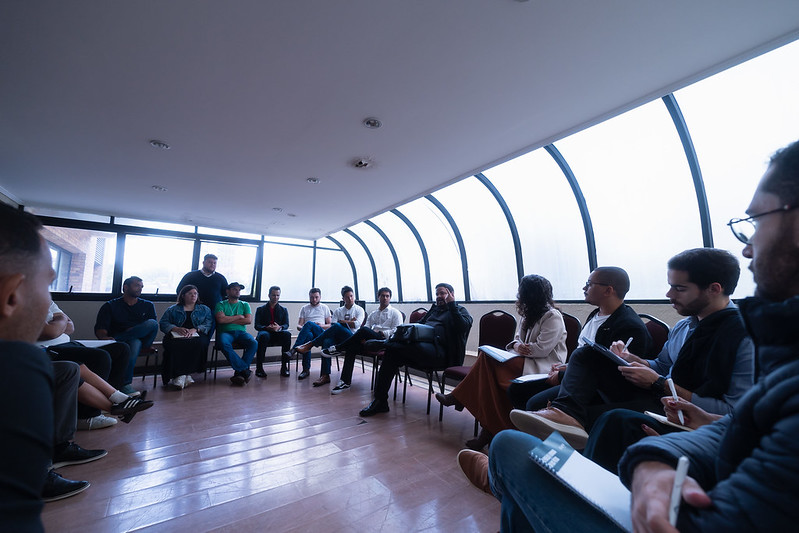
Last Saturday (28), political marketing strategist Juarez Guedes shared reflections on the challenges and paths of political communication in contemporary campaigns, in a conversation circle with participants of 4th edition of the Legislative Leadership Program, led by Legisla Brasil in partnership with RenovaBR.
For him, more than reaching large audiences with creative pieces, it is essential to generate emotional connections, build networks of trust and provoke public conversations capable of mobilizing people in a genuine way – online and, mainly, on the streets.
The importance of purposeful planning
A political marketing strategist who has participated in the coordination of majority and proportional campaigns in projects in all regions of the country, Juarez argues that a successful campaign requires clear executive planning, with creative pieces that not only inform, but also touch people and transform them into multipliers of the message. For him, success does not lie in the complexity of the ideas, but in the simplicity and authenticity with which the message connects with the voters' daily lives.
“Political communication only makes sense if it provokes movement. In the Legislature, there is already an environment of noise and fragmented attention. Therefore, it is easier for the candidate to end up producing content that is of no interest to anyone and that is not relevant,” the specialist points out.
What converts, according to the publicist, is conversation between people — and that is where sectors of the right, in his view, have been most successful on the global stage.
No fixed rule: the political scenario in constant transformation
During the discussion, Juarez highlighted that there are no permanent rules in political communication. That is, the speed of transformations in the digital environment and in voter behavior prevents the consolidation of lasting theses.
In this context, campaigns end up being pressured to follow “extraordinary” models – cases recognized as successful – which can often generate anxiety and strategic suffocation.
Experiences and lessons learned from a polarized campaign
During the conversation, Juarez recalled his work on the campaign of a candidate for the Senate in Minas Gerais, in a highly polarized context. He commented on how there are cases in which digital media can be decisive. In this case, the social media environment was important to give visibility to the opponent, but it also pointed out the limits of this presence when disconnected from the reality of the electorate — revealed, for example, in the rejection of an advertising piece that had been considered promising by the marketing team.
Although he recognizes the power of digital technology, the expert warns against a false sense of comfort generated by automated platforms and highly technological strategies. He argues that presence on the streets — through meetings, mobilizations, and active listening — will be the differentiator in future campaigns. He cites, as an example, the campaign of Ricardo Nunes, current mayor of São Paulo, in the 2024 municipal elections, driven by city councilors and local leaders with direct involvement in the territory.
Recalling ideas that have already been implemented, Juarez emphasizes that digital media should be used to build relationships with an engaged base, and not just as a tool for distributing pamphlets. More than testing formats, it is necessary to understand public sentiment, as people tend to vote based on the emotions they experience, and not just the ideas they receive.
Juarez also spoke about the potential of institutional communication in governments and city halls. For him, this communication should go beyond the ideological bubble and seek consensus, unlike political communication, which is more focused on mobilization. He claims that both Lula and Bolsonaro wasted opportunities by using institutional communication to strengthen their own bases, instead of expanding them.
Thinking about candidates with limited resources, Juarez shared the example of São Bernardo do Campo, where meetings with small groups in garages had a real impact. According to him, this direct, eye-to-eye contact has a powerful reverberation effect, especially for those who do not have an extraordinary network structure.
In an environment of exchanges with leaders from all over the country, the discussion with specialist Juarez Guedes brought reflections that reinforce more careful approaches to leadership communication: in addition to mastering the digital world, it is necessary to reconnect with people. Communication is needed that is capable of mobilizing, through listening, real connections and movements.
Photo: Luis Madaleno and Luis Cardoso


