This month, RenovaBR launched an exclusive immersion program on democracy, dedicated to young people aged 15 to 20 interested in politics and education. The first edition of “Young Democrats” It takes place over four weeks in which participants have experience in a work environment, in addition to learning about the training developed by the organization and connecting with political practice.
Based on their profiles and interests, students engage with RenovaBR projects, delivering practical projects while receiving ongoing support from the team. With a 20-hour workweek, students complete daily logs and technical analyses, resulting in a final presentation of their contributions and insights gained during the immersion.
In this first edition, participants were divided into projects such as the evaluation of continuing education carried out by RenovaBR in partnership with Latin American schools from the Democracia+ Network; analyses of the Central das Emendas (Amendment Center) and the preparation of thematic briefings on electoral inequalities based on RenovaBR's Municipal Electoral Inequality Map.
Youth participation in politics
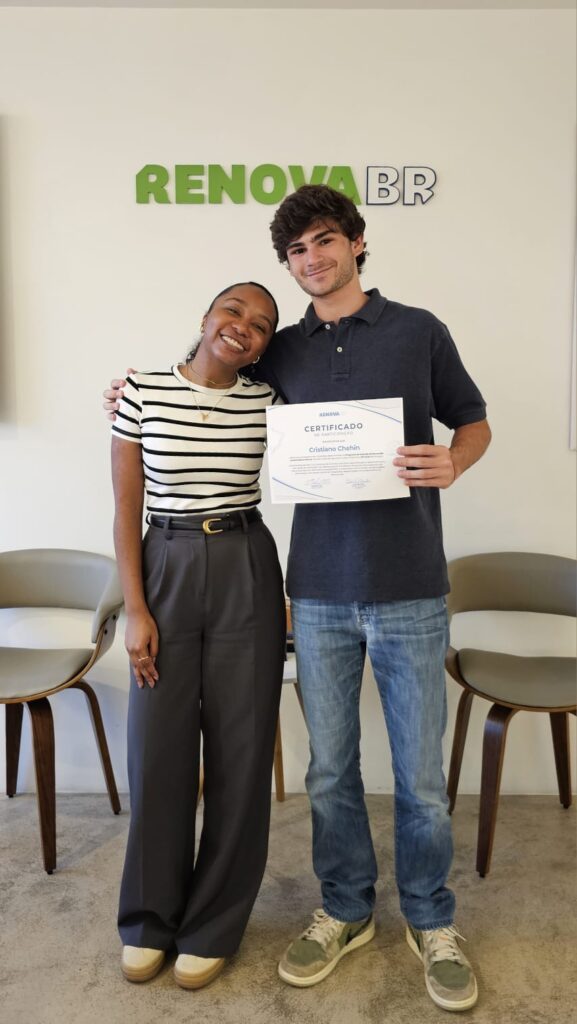
For Cristiano Chehin, a sophomore in high school, the immersion was crucial in helping him gain a clearer vision of his future career choices. But beyond that, the experience provided him with more knowledge about topics that interest him. "It's always good to be aware of politics, because it's an issue that's constantly changing rapidly," he shares.
During his four weeks at RenovaBR, Cristiano dedicated himself to analyzing feedback from the first edition of the Inter-American Public Leadership program, part of the continuing education program carried out in partnership with the Organization of American States (OAS) and the Democracia+ Network.
In the current scenario, where political renewal necessarily involves valuing youth, the importance of offering them real leadership prospects stands out. "It's important for young people to have leadership prospects," he states. For Cristiano, the foundation for transformation lies in education and the belief that young people have the power and space to change politics as well.
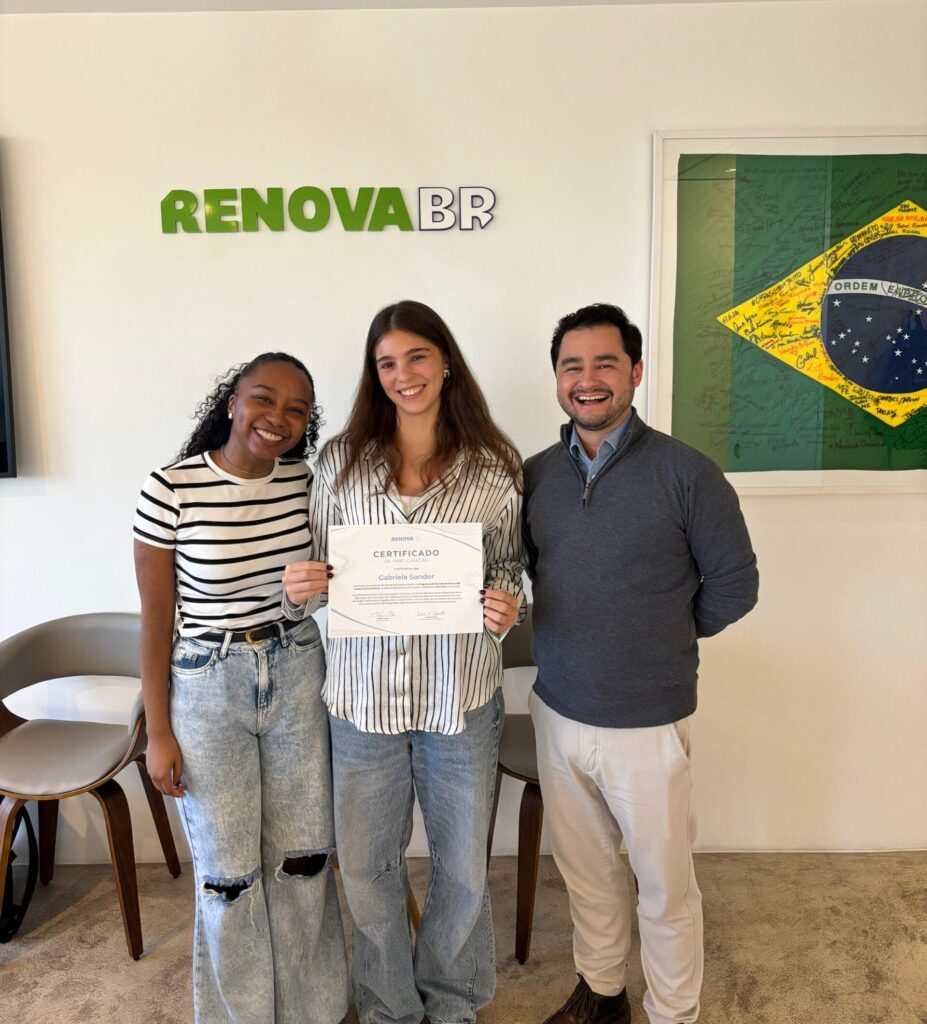
During her participation in the Immersion, Gabriela Sonders had the opportunity to contribute to the data analysis of the Municipal Electoral Inequality Map, creating graphs and interpretations to support the project's communication. Finishing high school in Hong Kong and on vacation in Brazil, she sought practical experience related to topics that interest her, such as politics and education.
"I've always wanted to do something that helps other people, other communities. Being part of RenovaBR has shown me that it's possible to do this in a concrete way, with data, research, and real impact, and still work with purpose," says Gabriela.
For Rodrigo Souza, a political science student at Notre Dame University in the United States, youth are crucial to political change. He says immersion in RenovaBR is an opportunity to learn more about Brazilian politics.
Working on analyses of parliamentary amendments, based on data collected by the Amendments Center, Rodrigo points out that understanding how municipal budget allocation works and its impacts is essential for a broader perspective.
Along the same lines, Theo Gekker, a politics, philosophy, and economics student at King's College London, points out that youth participation in politics is key to bringing about concrete change, whether through active participation or through seeking information. At the same time, he recognizes that younger generations tend to distance themselves from this environment and that organizations like RenovaBR can help demystify such complexity.
The ongoing program highlights the transformative potential of youth when aligned with knowledge and a commitment to democracy. By offering a genuine learning environment, the "Democratic Youth" edition demonstrates that politics can be built with the perspective of engaged new generations willing to make a difference.


