After the 2024 elections, a survey developed by Eloá Monsores, from RenovaBR's Business Intelligence team, revealed alarming data on the underrepresentation of women and black people in Brazilian municipal politics. Municipal Electoral Inequality Map clearly and accessibly exposes how gender, race and financing are still structural barriers to access to spaces of power.
In an interview, Eloá explains how data analysis can be a powerful ally in building a more plural democracy — and how RenovaBR has actively contributed to changing this scenario by training new leaders committed to representation and purpose.
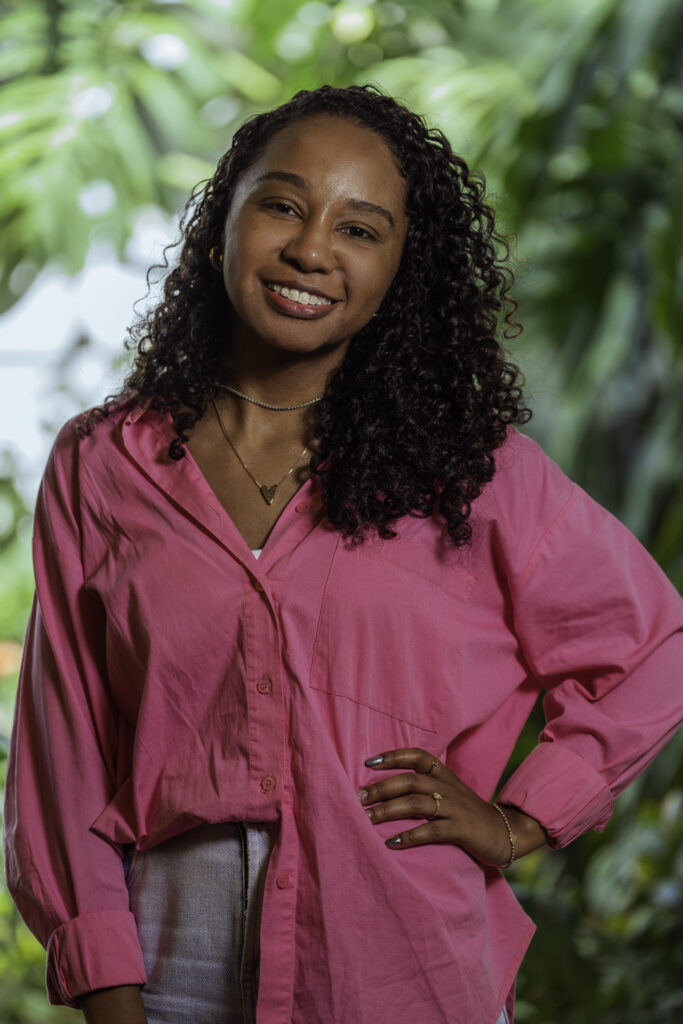
How long have you been part of the RenovaBR team and how would you describe your role here? I have been at RenovaBR for four years and I feel very privileged to have witnessed so many transformative stories up close. It is an honor to look back at everything we have achieved so far.
Today, I work on the Data & Research team, focusing on Business Intelligence. My job is to translate data into visualizations and insights that help organizations make more strategic and effective decisions, whether it’s tracking students’ journeys from the selection process to the RenovaBR Alumni network, or evaluating the impact of the actions of those elected. For me, data is not just numbers; it’s a way of connecting information, strategy, and purpose, creating solutions that directly contribute to shaping the future leaders of our country.
You were responsible for leading the development of a report called the Municipal Electoral Inequality Map. Can you tell us what motivated you to create this research? After the October 2024 elections, some questions began to arise, such as: “who are, in fact, the people elected in Brazilian cities? Do the new leaders reflect the real composition of the population? Or rather, who is being left out of politics?” The idea for the Map arose precisely from this discomfort. From realizing that, often, those who feel the impacts of political decisions the most are those who have the least voice in decision-making spaces.
Of course, this debate does not start now. It is a discussion that is based on an important trajectory of journalistic analysis, academic research and other studies that shed light on electoral inequalities in Brazil. What we sought with the Map was to join this discussion, offering a broad, accessible and visual reading that would help to highlight patterns.
We look at these data with objective lenses, but also with empathy. Issues such as gender, race and financing sometimes make us see with a conditioned perspective, sometimes dazzled by victory, overlooking the shortcomings of the process. If the inequalities of the electoral process are not seen, they will continue to be reproduced election after election.
What does the Electoral Inequality Map reveal most urgently? Can you comment on any data that caught your attention during the analysis? One of the data that impacted me the most was realizing how scarce the female presence in City Councils still is. In 737 Brazilian municipalities, no women were elected councilors in 2024. And in another 1,631 municipalities, there is only one woman among the elected councilors.
The situation regarding female representation in municipal executive positions is also worrying. In 2024, only 732 municipalities elected women to the position of mayor. This means that, for every 10 Brazilian municipalities, 9 are governed by men, highlighting the difficulty women face in occupying political leadership positions.
We are not just talking about numbers, but about an absence. Women who could be there sharing their experiences, defending urgent issues and building policies that are consistent with more than 50% of our population. And this absence has an explanation: women face a series of barriers not only to run for office, but also to remain in politics.
A study of the Alziras Institute showed that political gender violence is an everyday reality: attacks, silencing and boycotts discourage continuity. Furthermore, campaign funding is still concentrated in a few leaders, leaving most candidates without real support.
Why do gender and race need to be at the center of political analysis? Because gender and race are not just categories, they are life experiences. And these experiences shape how people experience politics on a daily basis. Using these cutouts allows us to observe more precisely how close or far the profile of elected officials is from the real composition of the population of each city. It also reveals where significant transformations are taking place, which often go unnoticed.
And this makes all the difference in how we formulate public policies and think about representation, in addition to evaluating whether we are, in fact, building a more plural and fairer democracy.
How important is this for democracy and what does RenovaBR do to contribute? Representation is essential because it ensures that different realities are reflected in decision-making spaces. The debate expands and solutions become more connected to real life. At RenovaBR, we are training leaders who not only reflect Brazil's diversity, but who are also prepared to engage in dialogue, listen and build collective solutions.
Among the students who applied in 2024, 40.1% were women and 41.8% self-identified as black or brown. These numbers say a lot about the type of transformation we want to promote: a more plural, better prepared and increasingly representative politics.
Can you tell us a number that gives you hope? In other words, an important advance that the Map numbers also bring? Even in the midst of so many inequalities, we found some data that gave us hope.
RenovaBR students had an electoral success rate of 16,10%; more than double the national average for women, which was 6,93%. This data shows that quality political education can make a difference, especially when accompanied by community, monitoring and strategy.
And we cannot fail to mention the issue of public campaign financing. Female students from RenovaBR, for example, stood out in this scenario, because they received, on average, more public funds than male students. But this data comes with a warning, because much of the funding allocated to female candidates in Brazil is concentrated in a few high-visibility female campaigns, while many others continue to face difficulties in raising the minimum amounts to make their candidacies viable.
In terms of race, 46% of the city councilors elected in 2024 self-declared as black or brown, an improvement over 2020, but still below the 56% that make up this portion of the Brazilian population. In addition, 33% of the municipalities elected black, brown, and indigenous mayors. Again, these numbers need to be read carefully. Studies such as the one by GEMAA show that almost 4 in 10 candidacies of self-declared black, brown, and indigenous people were not confirmed by heteroclassification, which reveals the complexity of measuring representation based solely on racial self-declaration.
In other words, the numbers that bring hope also require critical thinking. But they also show that it is possible to transform politics with more diversity and more preparation.
Finally, what can Brazilian politics gain from taking this data seriously? Data helps us identify where gaps still exist and where opportunities for progress lie. It offers us a mirror of reality that we often insist on not looking at.
Good policy starts with listening, and data is a way to listen and visualize what reality is trying to tell us. It reveals where inclusion is failing, where inequality is recurring, and where there are signs of change.
If we want to build fairer cities, we need to start by listening carefully. And only with a real diagnosis can we promote true, sustainable and purposeful transformations.


